











Short answer: a twin-tube damper uses two concentric tubes — cheaper to build, more compliant on rough roads, quicker to fade under sustained hard use. A monotube damper uses one tube with a separating piston — a larger piston area, better heat dissipation and more consistent behaviour when pushed, at the cost of a firmer feel and higher internal pressure. For a distributor, the question is not which is "better" but which one your customers will complain about less.
Most coilover arguments online are really arguments about use case. A twin-tube kit set up for a daily driver does its job; the same kit on a track day will fade. A monotube kit on a badly surfaced city road can feel harsh enough that the customer blames the spring. Here is the engineering difference, and the commercial decision that follows from it.
The construction difference, in one pass
| Twin-tube | Monotube | |
|---|---|---|
| Construction | Two concentric tubes; oil in the inner working tube and the outer reservoir, gas charge in the outer tube | One pressure tube; oil and a high-pressure gas charge separated by a floating piston |
| Piston area | Limited by the inner tube diameter | Larger for the same external body size |
| Heat | Heat is trapped in the outer tube; performance drifts as oil temperature rises | Oil is in direct contact with the outer wall; heat leaves the damper faster |
| Typical feel | Softer initial response, more compliance over small bumps | Firmer, more immediate, more consistent as load builds |
| Packaging | Longer body for the same stroke; harder to invert | Compact; can be run upside down |
| Cost to build | Lower | Higher |
What "inverted" adds
In a conventional MacPherson strut, the damper shaft takes the side loads from the wheel. An inverted strut flips the arrangement: the larger tube becomes the structural member and the shaft is protected inside it. The practical benefits are stiffness under cornering load and less bending stress on the shaft — which is why inverted designs dominate rally and circuit use. The trade-off is packaging, weight in some layouts, and cost.
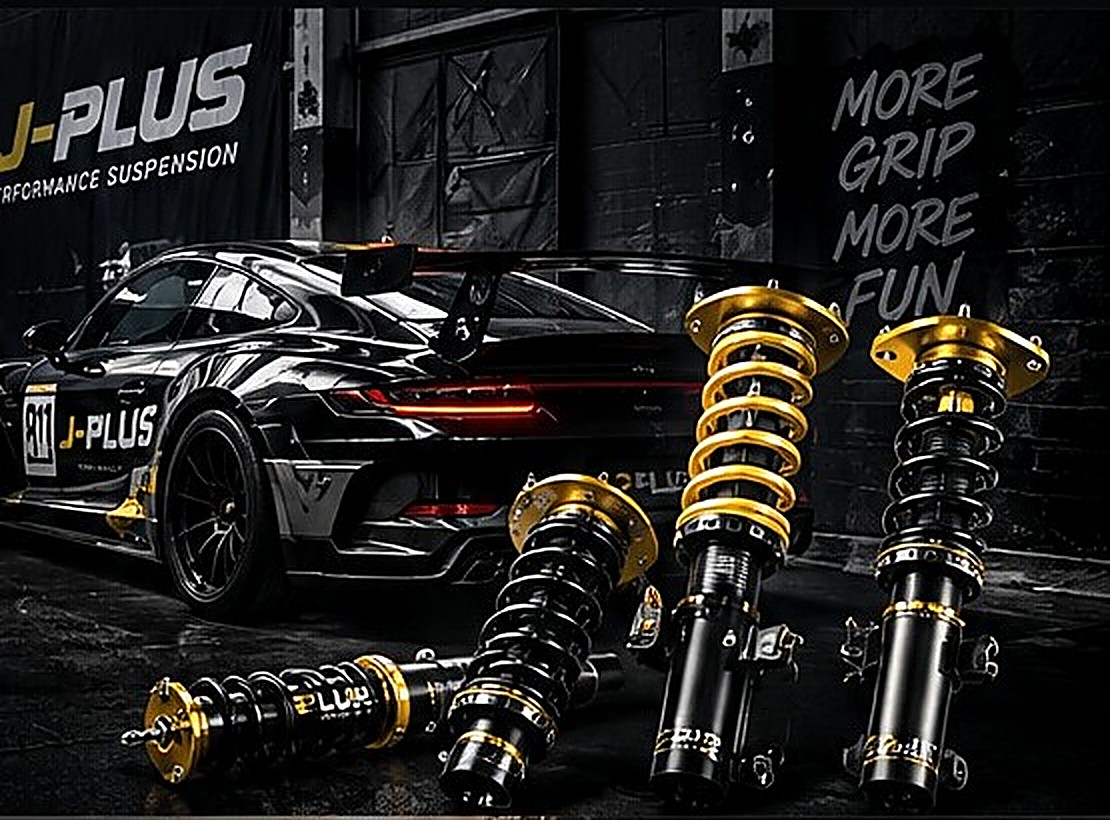
This is why our range separates single-tube and inverted versions, each in street, sport and racing builds: the choice of tube design and the choice of use case are two different decisions.
How to decide what to stock
Stock twin-tube if your customers are mostly street drivers
Rough surfaces, mixed loads, long service intervals without maintenance. Twin-tube kits are more forgiving of bad roads and cheaper to land at a competitive retail price. The failure mode — fade after repeated hard use — rarely shows up in normal driving.
Stock monotube if your market includes track days, mountain roads or performance builds
Anywhere the damper is asked to work hard for more than a few minutes at a time. The larger piston area and better heat path mean the behaviour at the end of a session still resembles the behaviour at the start.
Stock inverted if you sell into rally, gravel or serious track use
Side-load stiffness is the reason. If your customers are breaking shafts or feeling vagueness under load, the inverted design is the structural answer rather than a valving answer.
Carry both if you sell to workshops rather than end users
A workshop buys what the car in front of it needs that week. Having street and sport versions under one brand makes you the one-stop supplier instead of the supplier who has "the other one".
The myth worth correcting
"Monotube is premium, twin-tube is budget" is a simplification that costs distributors money. A well-valved twin-tube on the right spring rate outperforms a badly specified monotube on a street car, and it will not generate the "too harsh" complaint that ends with a refund. The damper design has to match the road and the driver, not a price tier.
FAQ
Is a monotube coilover always stiffer?
It feels firmer, largely because of the higher gas pressure and the faster response to small inputs. Between two kits with different spring rates, though, spring rate dominates what the driver feels.
Can a twin-tube be rebuilt?
Serviceability depends on the specific design rather than the category. Ask your supplier directly whether the unit is serviceable and what parts are available — a rebuildable kit is a selling point for workshops.
Which design lasts longer on bad roads?
Neither design is inherently fragile, but a monotube's high internal pressure puts more load on seals, and a twin-tube's heat retention punishes sustained hard use. Match the design to the duty cycle rather than to a durability claim.
See the range
Single-tube: street, sport, racing. Inverted: street, sport, racing. Chassis coverage is in the fitment guide.
Not sure which build suits your market? Tell us the vehicles, the roads and the customer type — the factory will recommend a build rather than a price tier.